

Anchors across Time
A 900-pound vault, an iPhone 17 Pro Max, and a newspaper, buried on July 4, 2026 to force a 250-year collision with the future.


Time is a relentless architecture - an unyielding dimension that stretches onward while simultaneously trapping us inside a fleeting, imperceptible present. The human instinct to resist this linear decay finds its most profound expression in the creation of a time capsule: a deliberate gravity well designed to warp our perception of chronology itself. To bury a vault is to engage in a paradox with an unwritten future, intentionally freezing an isolated configuration of matter so that it may bypass the natural erosion of time. It operates not merely as a storage container, but as a cinematic cut across centuries, forcing an absolute collision between two distinct coordinates in the continuum of human consciousness.
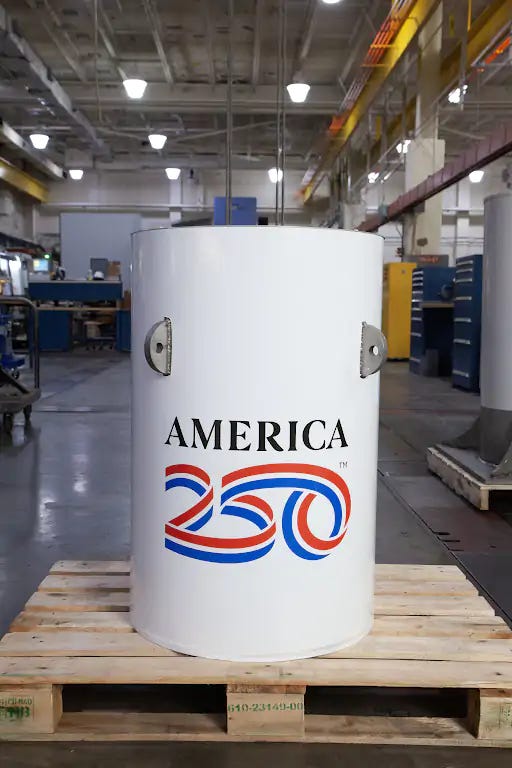
This intersection of temporal planes took physical form at Independence National Historical Park, where a massive 900-pound stainless steel cylinder was lowered deep into the earth. Throughout time various countries have buried time capsules over the course of time but today - it is for America’s semiquincentennial anniversary. Sealed within its vacuum walls, contemporary society chose to preserve an iPhone 17 Pro Max alongside physical copies of printed newspapers - juxtaposing the hyper-accelerated evolution of digital silicon with the static, physical media of ink on paper. Encased together in total darkness, these objects instantly undergo a metamorphosis: severed from cellular networks and daily news cycles, they cease to function as active instruments of communication and transform into monuments of frozen momentum.
When these preserved artifacts are eventually retrieved in the year 2276, the encounter will inevitably reveal the fundamental distortion inherent to historical memory. An iPhone, designed for the immediate fluidity of touch and real-time connectivity, will exist only as a silent, non-functional sculpture of glass and titanium, its internal lithium-ion battery long degraded into dead chemical matter. The newspaper will present a fractured narrative, offering headlines detached from the living, breathing urgency that gave them meaning. The observers of that distant era will look back at our cutting-edge tech not with our lived experience, but through the filtered lens of their own advanced reality, reading our crowning achievements as primitive steps in a long-completed evolution.
Yet, despite this inevitable detachment, the choice to seal these items remains an extraordinary tribute to human ingenuity and intent. The newspaper captures the tangible, human voices of our daily lives, while the device stands as a physical testament to our relentless drive to design, connect, and process the world around us. By placing them side-by-side in a vacuum vault, we ensure that the historians of 2276 won’t merely read about us in digital archives; they will hold the exact physical materials we crafted with our own hands, gaining a rare, unfiltered glimpse into the energy and creativity of the society that built the foundation they stand on.
Ultimately, the true architecture of a time capsule does not reside in the physical resilience of its outer shell, nor does it depend on the mechanical survival of its contents - it exists in the deliberate act of capturing a single, honest reflection before the river moves on. In that sense, even this post is its own quiet time capsule: a arrangement of words, thoughts, and digital signals frozen in this exact present, launched forward into an uncertain future. Whether forged in 900 pounds of steel beneath the dirt or woven out of sentences on a screen, every attempt to articulate who we are right now is born of the exact same radical optimism - a message sent through the dark, trusting that someone, somewhere down the line, will still be waiting to decode the past.